Holiday shopping season: coin value worksheets for special education money practice
Money comes up everywhere in late fall. Black Friday is Friday, November 27, 2026, the day after Thanksgiving, and Giving Tuesday follows on December 1. Store flyers, class fundraisers, and holiday gift lists all lead to the same classroom question: does a student know what each coin is worth? This post shows three short SkillSprout coin sheets you can print for the shopping weeks, from naming coin values to comparing two groups of coins.
These are plain skill practice pages. They do not have store pictures, price tags, or holiday art. Coins are shown as their names in a printed oval, so you can pair the page with real or play coins at the table.
Grade 2: how many cents is one coin worth?
The Grade 2 Essential Element M.EE.2.MD.8 reads: "Recognize that money has value." The Grade 2 coin values worksheet asks one question at a time, such as "How many cents is one quarter worth?" This sample uses three-option multiple choice, so a student can circle an answer or point to it.
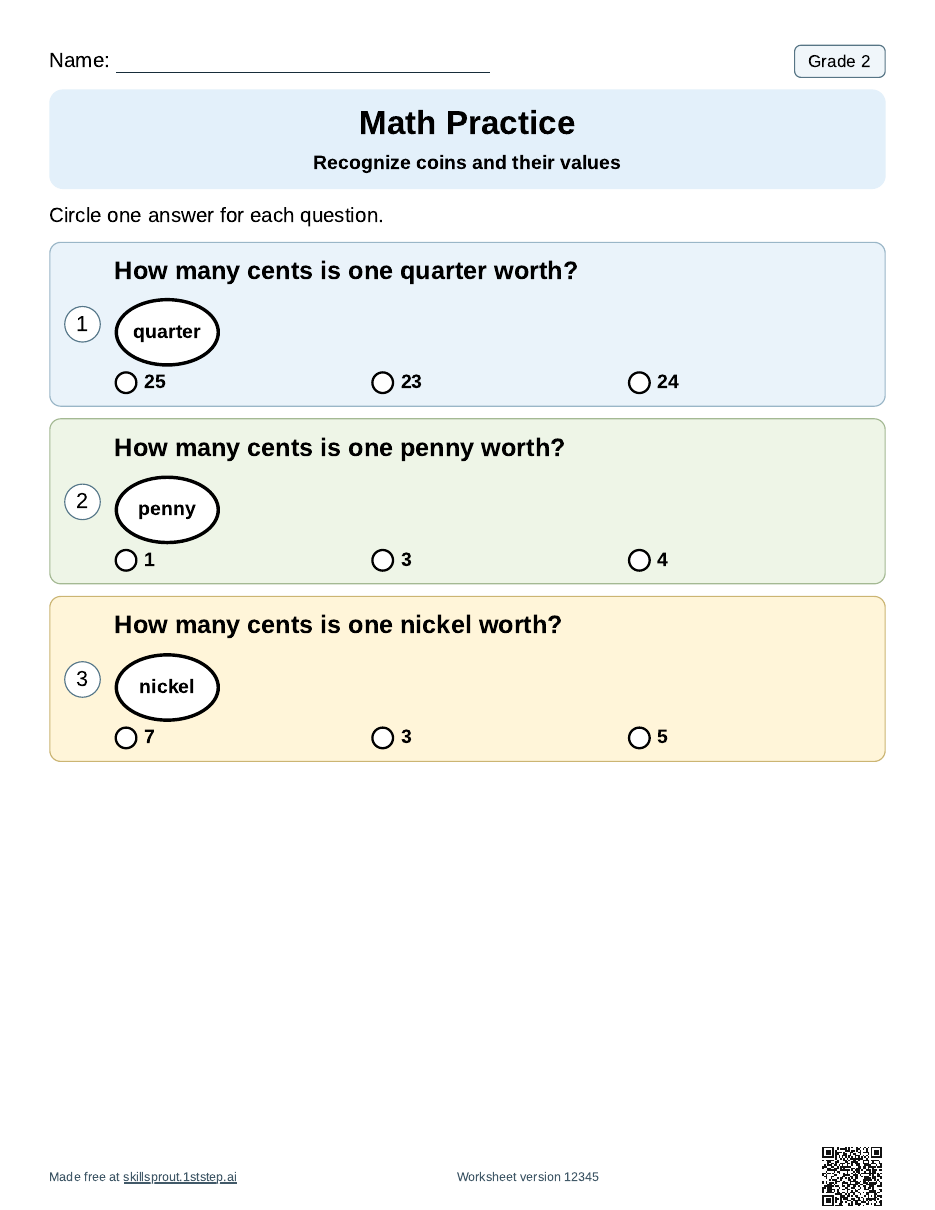
The three questions on this version ask about a quarter, a penny, and a nickel. The answers are 25, 1, and 5.
Grade 4: write the value of each coin
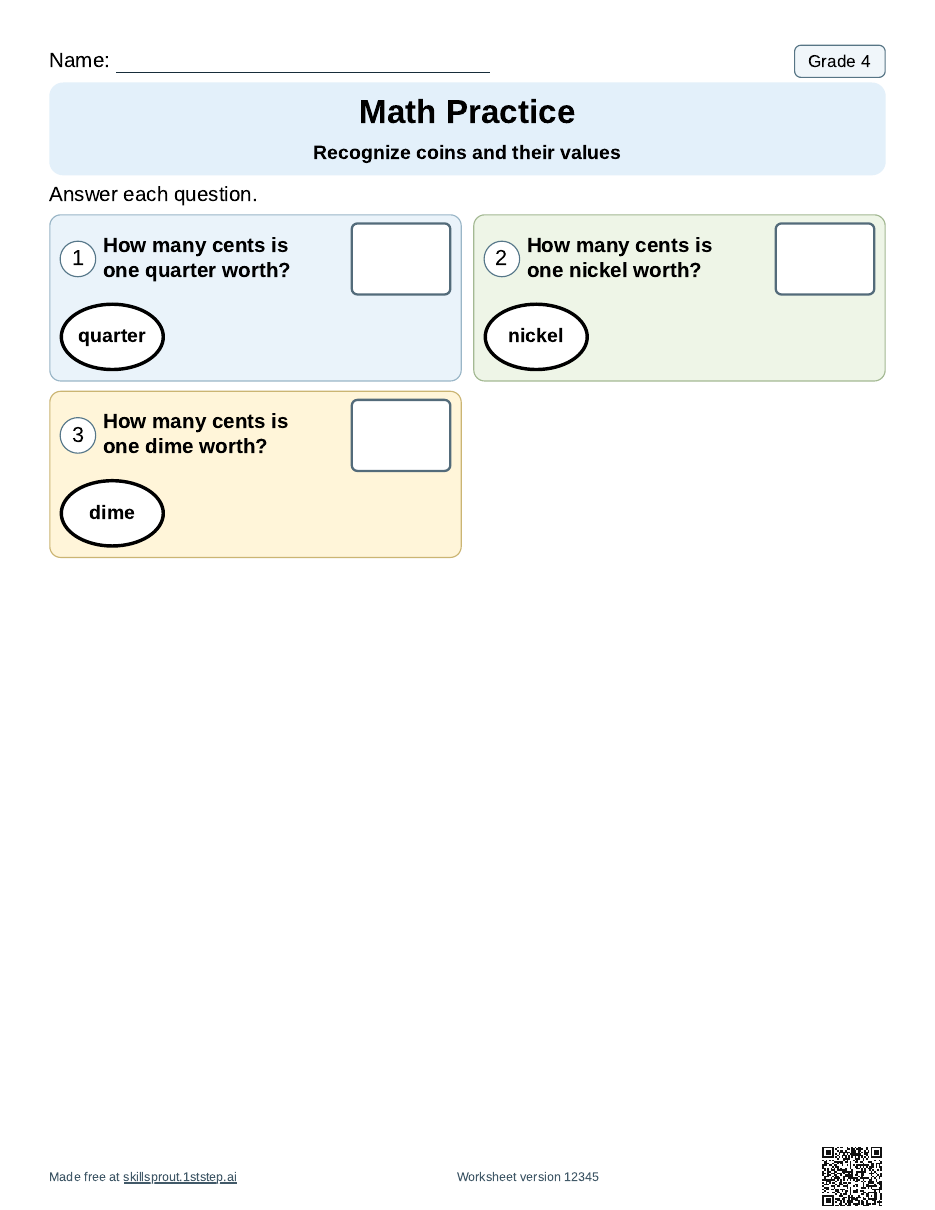
The Grade 4 Essential Element M.EE.4.MD.2.d reads: "Identify coins (penny, nickel, dime, quarter) and their values." The Grade 4 coin values worksheet practices the same idea with a write-in box for each answer.
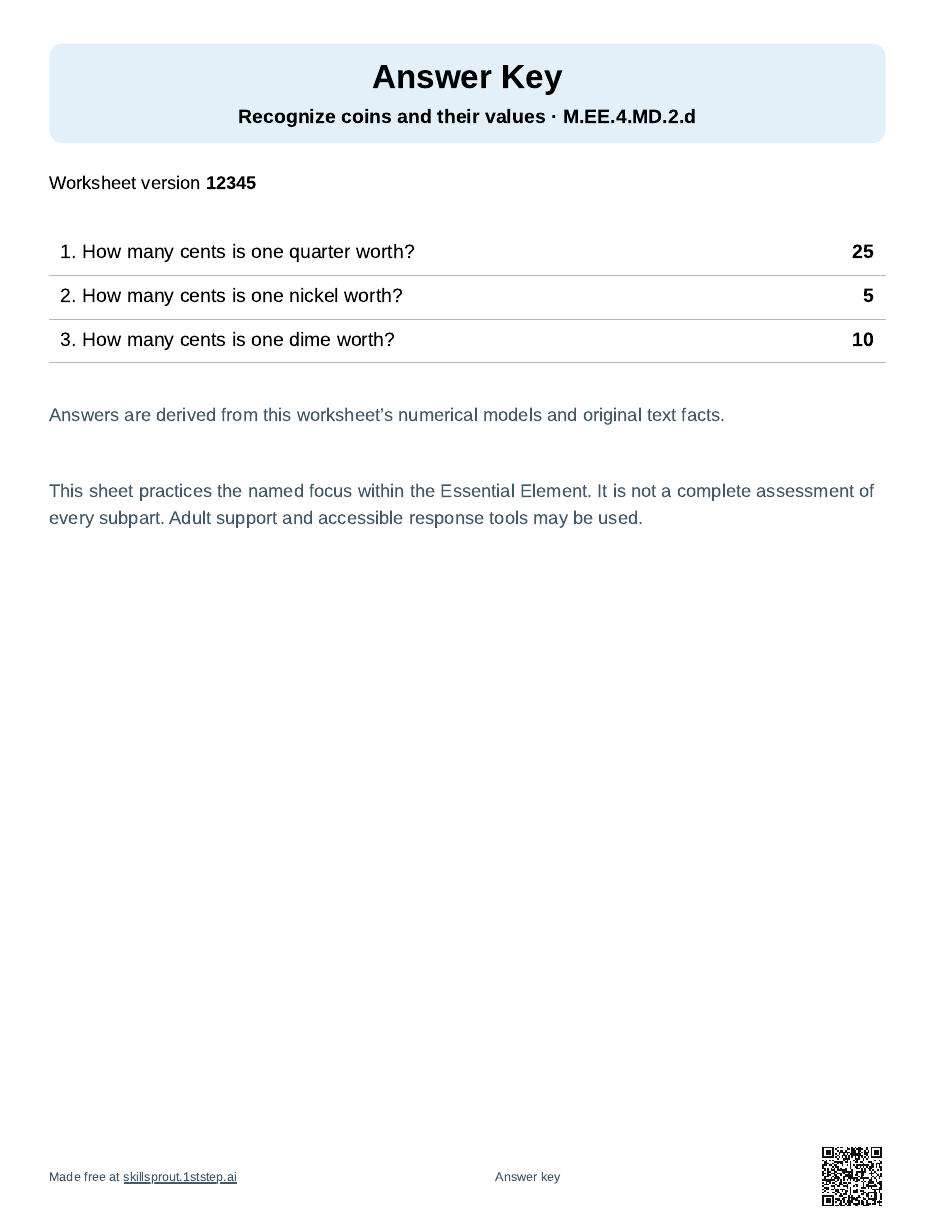
The answer key prints on its own page after the student page, with the skill, the Essential Element code, and the worksheet version.
Grade 5: which group of coins is worth more?
Shopping is not only about one coin. The Grade 5 Essential Element M.EE.5.MD.1.c reads: "Indicate relative value of collections of coins." The Grade 5 compare coin collections worksheet shows two collections, A (nickels) and B (dimes), and asks which one is worth more.
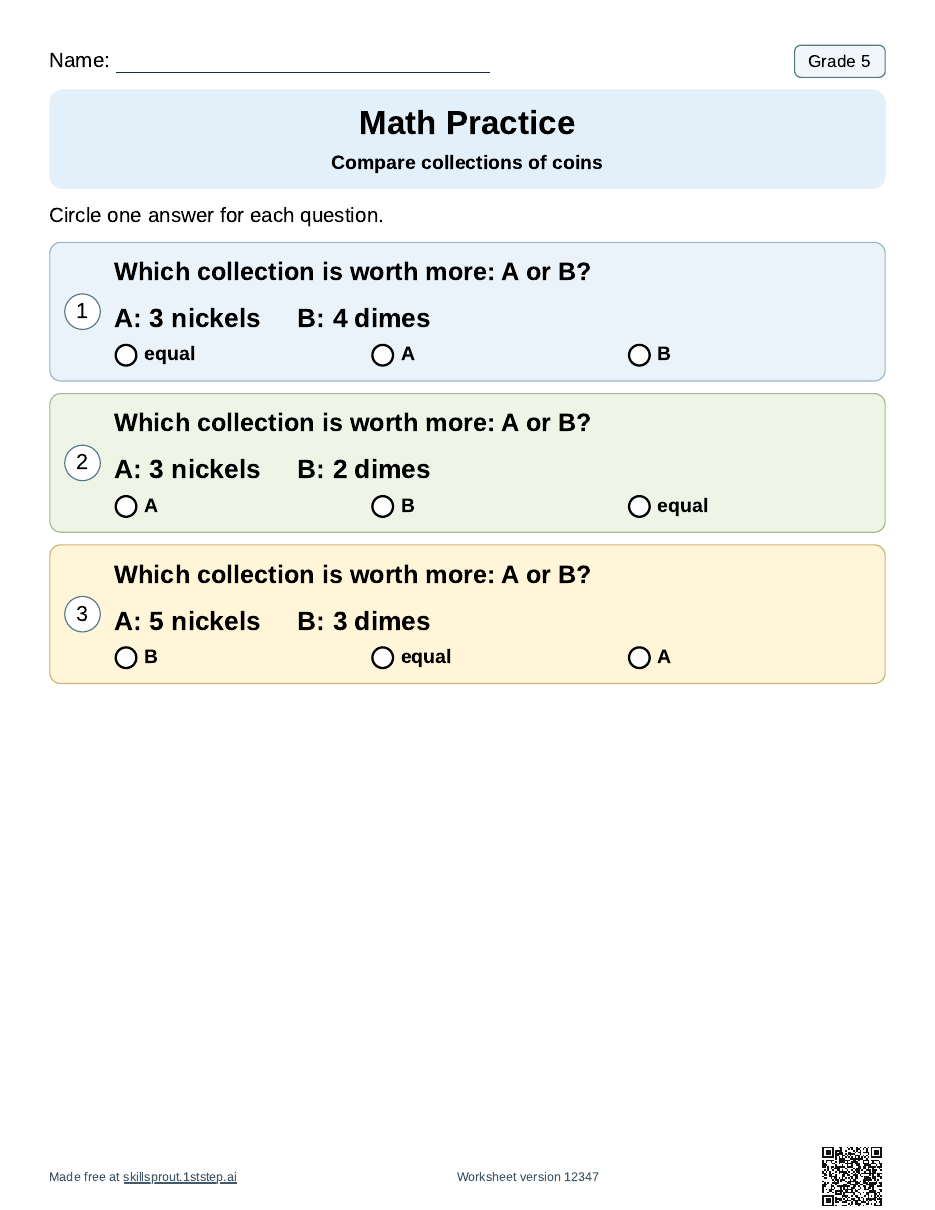
On this version, the collections are 3 nickels and 4 dimes, 3 nickels and 2 dimes, and 5 nickels and 3 dimes. Dimes are worth more on all three, so the answer each time is B (40 cents, 20 cents, and 30 cents against 15, 15, and 25). That makes it a good sheet to talk through: fewer coins can still be worth more. A different worksheet version gives different pairs.
Write down what you see on a blank data sheet
If you want to note coin practice before and after the shopping weeks, the blank classroom data sheet maker prints an empty recording sheet. This one uses accuracy, 5 rows, and 3 trials, one column for each question on a 3-question page.
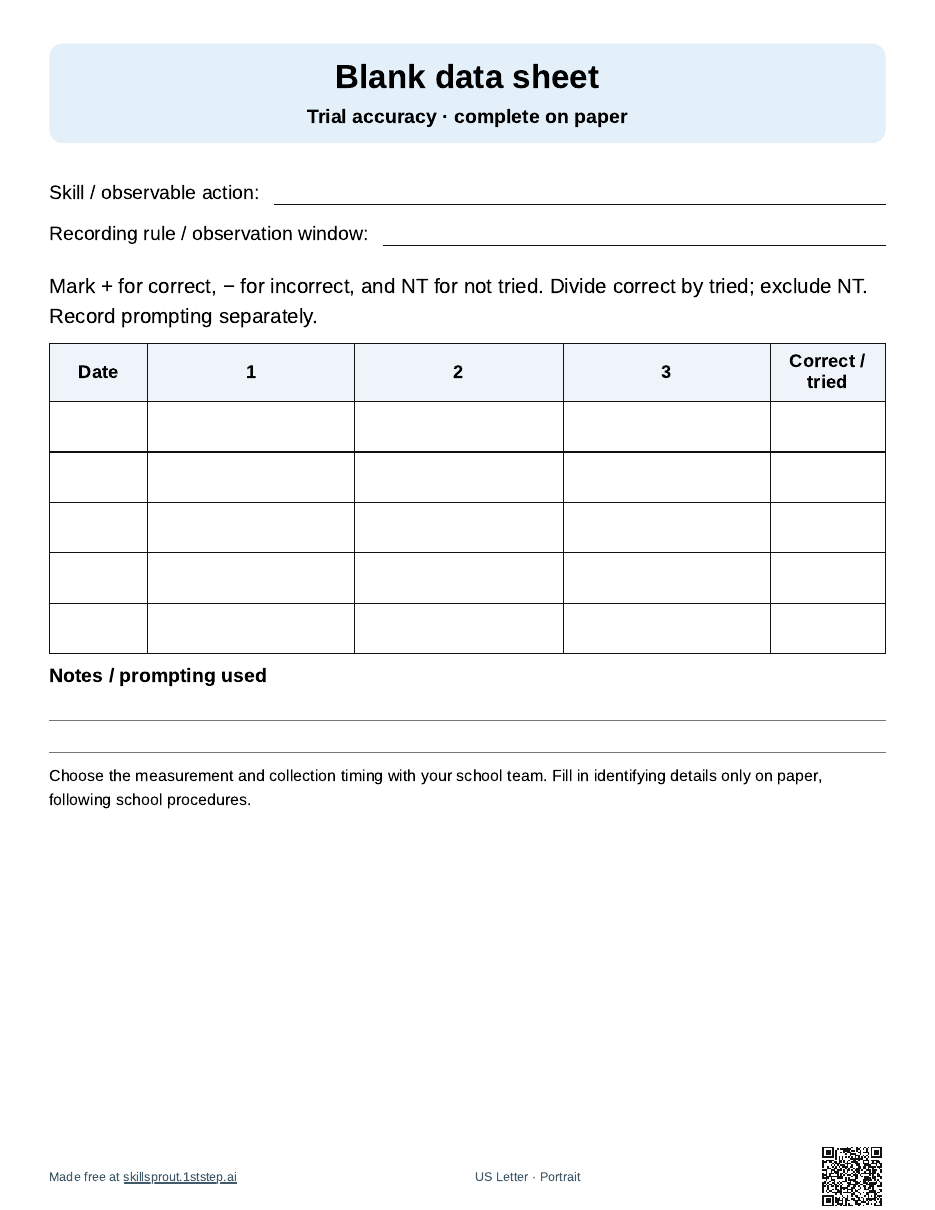
The sheet only gives you spaces to record on paper. It does not choose goals or interpret progress, and nothing written on it goes into the app.
Ways to use the sheets this season
- Print the Grade 2 or Grade 4 page the week before Thanksgiving break and again in early December with the same worksheet version, so the questions match.
- Put a few real or play coins next to each question, so students can hold the coin while they answer.
- Use the Grade 5 page before a class fundraiser or classroom store day to talk about why a group of dimes can be worth more than a bigger group of nickels.
- Mix a coin skill with other skills your class has practiced in the mixed skill review pack maker, which combines up to five ready activities in one print.
How to print them
- Open the SkillSprout studio. The studio uses Google sign-in. The worksheet pages linked above are public to browse.
- Choose the coin skill for your grade, then set the number of questions and the response format, such as write-in or multiple choice.
- Keep the answer key on. To print the exact sheets shown here, enter the worksheet version from the caption, or keep your own number and write it down.
- Check the preview, then print or download the PDF.
The name line prints blank, and the studio does not ask for student names, diagnoses, or student work. Each worksheet page quotes the published Essential Element wording. A combined standard can include parts a single sheet does not practice, so check the sheet against your student's goals before you print. SkillSprout is an independent tool and is not affiliated with Dynamic Learning Maps.